Executive Summary
As energy costs fluctuate and global focus shifts towards sustainability, upgrading building insulation remains one of the most effective ways to reduce carbon footprints and lower utility bills. However, insulation is not a one-size-fits-all solution. This case study explores how targeted insulation strategies—varying by property age, construction type, and architectural design—directly impact energy efficiency and thermal comfort.
1. Introduction: The Core Importance of Insulation
Insulation acts as a barrier to heat flow, keeping a property warm in the winter and cool in the summer.
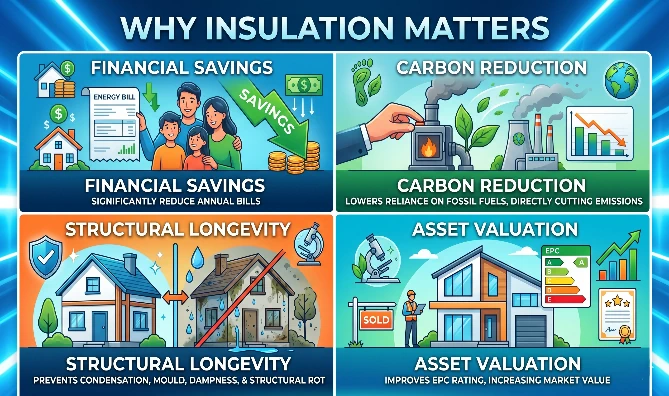
Why Insulation Matters
- Financial Savings: Can significantly reduce annual bills.
- Carbon Reduction: Lowers reliance on fossil-fuel-based heating systems, directly cutting greenhouse gas emissions.
- Structural Longevity: Correctly installed insulation prevents condensation, reducing the risk of mould, dampness, and structural rot.
- Asset Valuation: Improves the property’s Energy Performance Certificate (EPC) rating, increasing market value.
2. Property Types & Targeted Insulation Strategies
Different properties possess distinct architectural DNA, meaning an insulation material that works perfectly for a modern build could cause severe damp issues in a historic property.
3. Comparative Summary of Insulation Types
Insulation Type | Typical Lambda Value (W/mK) | Form/Application |
Aerogel | 0.013 – 0.020 | Flexible blankets, highly space-constrained areas |
Phenolic Foam | 0.018 – 0.021 | Rigid boards, maximum thermal efficiency |
PIR (Polyisocyanurate) | 0.022 – 0.023 | Rigid boards (foil-faced), most common for walls/floors |
PUR (Polyurethane) | 0.023 – 0.028 | Rigid boards or spray foam |
VIPs (Vacuum Insulation Panels) | 0.008 – 0.005 | Rigid panels (extremely high performance, highly fragile) |
XPS (Extruded Polystyrene) | 0.029 – 0.038 | Rigid boards, moisture-resistant (often for DPC levels) |
EPS (Expanded Polystyrene) | 0.030 – 0.045 | Rigid boards, lightweight and affordable |
Glass Wool | 0.032 – 0.044 | Flexible rolls/batts, general loft and stud wall spaces |
Stone Wool (Mineral Wool) | 0.034 – 0.040 | Semi-rigid batts, excellent for acoustic and fire resistance |
Cellulose | 0.035 – 0.040 | Loose-fill or blown-in, eco-friendly (recycled paper) |
Sheep Wool | 0.035 – 0.040 | Flexible rolls, natural and moisture-regulating |
4. Energy Efficiency Improvements & Measurable Outcomes
To demonstrate the real-world impact of these interventions, consider the data below detailing average heat loss vectors and post-insulation improvements:
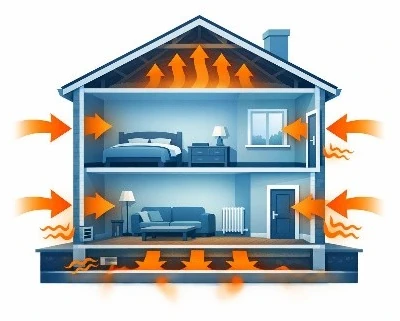
Typical Heat Loss Breakdown in an Uninsulated Home
- Roof / Loft: ~25%
- Walls: ~35%
- Windows / Doors: ~15%
- Floors: ~15%
- Draughts / Ventilation: ~10%
Key Performance Indicators (KPIs) Post-Upgrade:
- 1. U-Value Reduction: The U-value (thermal transmittance) measures how effective a fabric component is as an insulator. Post-insulated walls typically see U-values drop from 2.1 W/m²K to 0.30 W/m²K or lower, representing an 85% reduction in heat transmission rate through the building fabric. The exact thermal transmittance drop depends entirely on the original wall construction type and the chosen upgrade method.
- 2. HVAC Cycling Optimisation: Properly insulated envelopes allow heat pumps or traditional boilers to run at lower, steadier, and more efficient temperatures rather than constantly cycling on and off.
- 3. Financial return: The property's market valuation increase is attributable to enhanced energy efficiency credentials. Properties with high efficiency ratings (typically EPC Bands A to C) command a price premium. Buyers are willing to pay upfront for a home that promises lower running costs, predictable thermal comfort, and future-proofed compliance.
5. Conclusion
A targeted insulation strategy must reflect the property’s age, construction and existing moisture behaviour.
This case study underscores that insulation is the foundational pillar of building energy efficiency. Fabric-first approaches—prioritising walls, roofs, and floors before upgrading mechanical heating systems—yield the highest environmental and financial dividends.
For any retrofitting or new-build project, understanding the unique structural properties of the building is paramount to selecting the right insulation type and ensuring long-term structural health.